


Quick Answer: Low testosterone in young men is more common than most people expect. The most frequent causes include chronic stress, poor sleep, obesity, sedentary lifestyle, heavy alcohol use, and underlying medical conditions like hypogonadism. Symptoms range from fatigue and low libido to mood changes and difficulty building muscle. A morning blood test measuring total and free testosterone is the only reliable way to confirm a diagnosis.
Can Young Men Actually Have Low Testosterone?
Yes. While testosterone decline is typically associated with men over 40, clinically low testosterone can occur at any age. Research suggests rates of hypogonadism in younger male populations are rising, likely driven by lifestyle factors including obesity, sleep disruption, and chronic stress.
Testosterone is not just a sex hormone. It regulates energy metabolism, muscle protein synthesis, bone density, mood, cognitive function, and cardiovascular health. When levels drop below the normal reference range and symptoms are present, the clinical term is hypogonadism.
At Get Gambit, Canada’s specialist-led telehealth clinic for men’s hormone health, we regularly assess testosterone in men in their 20s and 30s who present with symptoms that have gone unaddressed for years, often because low testosterone wasn’t on anyone’s radar.
What Causes Low Testosterone in Young Men?
Does lifestyle affect testosterone levels in young men?
Yes, significantly. Lifestyle is one of the most modifiable drivers of testosterone in otherwise healthy young men. Key factors include:
Sedentary behavior: Physical inactivity is associated with lower testosterone. Resistance training, in particular, has a well-documented acute and chronic positive effect on testosterone levels.
Diet quality: Diets low in healthy fats, zinc, and micronutrients impair testosterone synthesis. Testosterone is a steroid hormone derived from cholesterol, so chronically low dietary fat intake can limit production.
Sleep disruption: The body produces the majority of its daily testosterone during sleep, peaking in the early morning hours. Men who consistently sleep fewer than 7 hours show measurable reductions in testosterone levels.
Alcohol consumption: Chronic heavy drinking impairs the hypothalamic-pituitary-gonadal (HPG) axis, reduces testicular testosterone output, and depletes zinc, a key mineral in testosterone regulation.
Shift work and circadian disruption: Irregular schedules that disrupt the body’s natural rhythm can interfere with the hormonal signals that drive testosterone production overnight.
What medical conditions cause low testosterone in young men?
Several clinical conditions directly suppress testosterone:
Primary hypogonadism occurs when the testes fail to produce adequate testosterone despite normal signaling from the brain. Causes include Klinefelter syndrome, undescended testes, testicular injury, or prior infection (such as mumps orchitis).
Secondary hypogonadism occurs when the pituitary gland or hypothalamus fails to send the hormonal signals that stimulate testosterone production. Causes include pituitary tumors, hyperprolactinemia, and certain medications.
Chronic illness: Conditions including obesity, type 2 diabetes, kidney disease, and autoimmune disorders are all associated with lower testosterone. Visceral fat in particular increases aromatase activity, which converts testosterone into estrogen.
Does stress cause low testosterone?
Chronic stress raises cortisol, and cortisol has a suppressive effect on testosterone production at the level of the testes. Research published in the Journal of Cellular and Molecular Medicine (Xiong et al., 2021) demonstrated that chronic stress inhibits testosterone synthesis in Leydig cells through mitochondrial damage. This creates a feedback loop: low testosterone worsens stress tolerance, which further suppresses testosterone.
Depression and anxiety, whether as causes or consequences of hormonal imbalance, are also independently associated with lower testosterone.
Can genetics cause low testosterone in young men?
Yes. Klinefelter syndrome (47,XXY karyotype) is the most common genetic cause of primary hypogonadism, affecting approximately 1 in 500 to 1,000 men. Many cases go undiagnosed until men seek evaluation for infertility or symptoms of low testosterone. Other developmental conditions including undescended testes (cryptorchidism) can also reduce testosterone production if untreated.
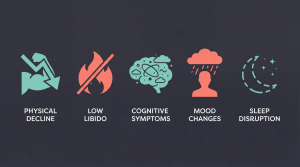
What Are the Symptoms of Low Testosterone in Young Men?
Physical symptoms
Reduced muscle mass and strength: Testosterone drives muscle protein synthesis. Men with low T often find they struggle to build or maintain muscle regardless of training volume.
Increased body fat, particularly abdominal: Testosterone regulates fat distribution. Low levels shift the balance toward fat accumulation, especially visceral fat around the abdomen.
Fatigue and low energy: Persistent, unexplained tiredness that doesn’t resolve with sleep is one of the most commonly reported symptoms of low testosterone.
Gynecomastia: An imbalance between testosterone and estrogen can cause breast tissue development in men. This occurs because low testosterone allows estrogen to exert a relatively stronger effect.
Changes in body hair and skin: Testosterone influences hair growth patterns. Thinning body or facial hair, or changes in skin texture, can reflect declining levels.
Sexual and reproductive symptoms
Reduced libido: A significant or persistent drop in sexual desire is one of the hallmark symptoms of low testosterone, distinct from normal day-to-day fluctuation.
Erectile dysfunction: While testosterone does not directly cause erections, it is essential for maintaining sexual function and libido. Men with low T frequently report difficulty achieving or maintaining erections.
Reduced fertility: Testosterone is required for sperm production. Low levels can reduce sperm count and motility, affecting fertility.
Cognitive and emotional symptoms
Brain fog: Difficulty concentrating, slower processing, and reduced mental clarity are frequently reported by men with clinically low testosterone.
Mood instability: Low testosterone is associated with increased irritability, emotional reactivity, and reduced stress tolerance.
Depression and anxiety: Low T can both mimic and worsen depressive symptoms. Men presenting with mood disorders, particularly those that haven’t responded well to standard treatment, should have their testosterone evaluated.
Sleep disturbances: Low testosterone disrupts sleep architecture, which in turn further suppresses testosterone production overnight. This cycle can be difficult to break without addressing the hormonal component directly.
Symptoms at a Glance
| Category | Common Symptoms |
|---|---|
| Physical | Fatigue, muscle loss, abdominal fat gain, gynecomastia |
| Sexual | Low libido, erectile dysfunction, reduced fertility |
| Cognitive | Brain fog, poor concentration, memory issues |
| Emotional | Irritability, depression, anxiety, mood swings |
| Sleep | Insomnia, non-restorative sleep |
Frequently Asked Questions About Low Testosterone in Young Men
What testosterone level is considered low in a young man? Most labs flag total testosterone below 300 ng/dL as low, though some guidelines use 264 ng/dL as the lower threshold. Free testosterone, which reflects the biologically active portion, is equally important. Symptoms matter as much as numbers. A man with a level of 280 ng/dL and significant symptoms is a stronger candidate for treatment than a man at 310 ng/dL with none.
How is low testosterone diagnosed? Diagnosis requires a blood test, ideally drawn in the morning between 7 and 10 AM when testosterone is at its daily peak. A single low reading is typically confirmed with a second test. A complete assessment should include total testosterone, free testosterone, LH, FSH, SHBG, estradiol, and prolactin to identify whether the cause is primary or secondary hypogonadism.
Can low testosterone in young men be treated? Yes. Treatment depends on the underlying cause and the patient’s goals, including whether fertility preservation is a priority. Options include testosterone replacement therapy (TRT), clomiphene citrate or HCG to stimulate natural production, and lifestyle interventions for men with borderline levels driven by modifiable factors.
Is testosterone replacement therapy safe for young men? TRT is effective and well-tolerated when properly managed. Key considerations for younger men include its suppressive effect on natural sperm production. Men who want to preserve fertility typically use alternative protocols that stimulate endogenous testosterone production rather than replacing it directly. All of this should be assessed and monitored by a licensed clinician.
When should a young man get his testosterone checked? If you’re experiencing two or more symptoms, including persistent fatigue, low libido, difficulty building muscle, mood changes, or brain fog, a blood test is the appropriate next step. There is no benefit to waiting.
How Is Low Testosterone Managed?
Lifestyle interventions
For men with borderline low testosterone driven by modifiable factors, lifestyle changes can produce meaningful improvements:
Diet: Prioritize whole foods, healthy fats, lean protein, and micronutrient-dense vegetables. Focus on zinc-rich foods (shellfish, red meat, pumpkin seeds) and vitamin D sources (fatty fish, eggs, fortified foods).
Resistance training: Compound movements performed consistently are among the most reliable natural stimulants of testosterone. Avoid chronic overtraining, which raises cortisol and suppresses testosterone.
Sleep: Prioritize 7 to 9 hours of uninterrupted sleep. Address sleep apnea if present, as it is a significant and often overlooked driver of low testosterone in men of all ages.
Stress reduction: Chronic cortisol elevation directly suppresses testosterone synthesis. Structured stress management, whether through exercise, mindfulness, or reducing workload, has measurable hormonal effects.
Alcohol reduction: Cutting heavy drinking is one of the fastest lifestyle changes that can improve testosterone levels.
Medical treatment
When lifestyle changes are insufficient or testosterone is clinically low due to a medical condition, the following options exist:
Testosterone replacement therapy (TRT): Available in injectable, topical, or other forms. Effective for symptom resolution but suppresses natural sperm production, making it less suitable for men actively trying to conceive.
Selective estrogen receptor modulators (SERMs) and HCG: Clomiphene citrate and HCG stimulate the HPG axis to increase natural testosterone production. These are often preferred for younger men who want to preserve fertility.
Addressing underlying conditions: Treating obesity, correcting nutritional deficiencies, or managing a pituitary condition may restore testosterone without direct hormone therapy.
What about supplements?
Some supplements, including ashwagandha, magnesium, zinc, and vitamin D, have evidence supporting modest benefits in men with deficiencies or chronic stress. They are not a substitute for clinical treatment in cases of true hypogonadism, but may be appropriate adjuncts. Consult a clinician before starting any supplement regimen.

When to Seek a Clinical Assessment for Low Testosterone
Symptoms of low testosterone are often dismissed as stress, aging, or poor sleep. In young men especially, the hormonal cause frequently goes unexamined for years.
Consider getting tested if you are experiencing:
- Persistent fatigue that doesn’t improve with rest
- A noticeable drop in sex drive or sexual performance
- Difficulty building or maintaining muscle despite consistent training
- Increased abdominal fat without significant dietary change
- Mood changes, irritability, or depressive symptoms
- Brain fog or reduced mental sharpness
- Sleep problems that have no clear explanation
Get Gambit offers virtual hormone assessments for men across Canada. Our process includes an online intake, a lab requisition covering 60+ biomarkers, and a clinician review with personalized recommendations, all without requiring an in-person visit. [Start your assessment at getgambit.ca.]
References
Xiong, X., Wu, Q., Zhang, L., et al. (2021). Chronic stress inhibits testosterone synthesis in Leydig cells through mitochondrial damage via Atp5a1. Journal of Cellular and Molecular Medicine, 26(2), 354–363. https://doi.org/10.1111/jcmm.17085
Heitz, D., Holland, K., & Walsh, K. (2024, April 29). Testosterone Tests: How They Work and Understanding the Results. Healthline. https://www.healthline.com/health/testosterone-test
Mayo Clinic. (2024, January 19). Testosterone therapy: Potential benefits and risks as you age. https://www.mayoclinic.org/healthy-lifestyle/sexual-health/in-depth/testosterone-therapy/art-20045728
Mayo Clinic. (2021, September 29). Male Hypogonadism. https://www.mayoclinic.org/diseases-conditions/male-hypogonadism/symptoms-causes/syc-20354881
Vale Health Clinic. (2023, August 3). Lifestyle Changes to Boost Testosterone Levels Naturally. https://valehealthclinic.co.uk/lifestyle-changes-to-boost-testosterone-levels-naturally/


